Showing posts with label UM janitors' strike. Show all posts
Showing posts with label UM janitors' strike. Show all posts
Thursday, April 26, 2012
Si se puede: the documentary
This documentary, "Si se puede," about the 2006 UNICCO strike at UM is now vieweable on Youtube. Relive the excitement!


Saturday, August 21, 2010
Deja Vu All Over Again: Four Years On.
Four years ago, workers janitors and grounds-keepers at the University of Miami, employed by the subcontractor UNICCO, went on strike to be allowed to form a union. After a long hunger strike, and with the support of students, faculty, clergy and local politicians, UNICCO agreed to recognize their membership in the SEIU. A four-year contract, with a living wage and a number of improvements in working conditions, was negotiated.
That was four years ago. Now the contract is up for renegotiation. The bargaining team for the workers have made a number of proposals for the new contract which have been rejected out of hand by UNICCO. Among these proposals are: 1) a new four-year contract; 2) a very modest 75c per hour wage increase to help offset the 9% increase in the cost of living in the last four years; 3) improved safety for workers at night; and 4) mandated rest periods for grounds-keepers when the temperature is above 100F. A further post will reproduce a more extensive list of the proposals.
Today, at the Venerable Bede Episcopal Church, the workers rallied and voted to authorize the bargaining team to call for a strike if a new contract is not agreed on by September 1st.
The strike four years ago was a harrowing experience for all concerned: the workers, students, faculty, and administrators. It is our fervent hope that another strike will not be necessary. But we are reviving this blog to provide information of developments and support for the workers. Should a contract be renegotiated successfully in the next couple of weeks, we will gladly lapse into quiescence again.
Watch this space!
Si se puede!
That was four years ago. Now the contract is up for renegotiation. The bargaining team for the workers have made a number of proposals for the new contract which have been rejected out of hand by UNICCO. Among these proposals are: 1) a new four-year contract; 2) a very modest 75c per hour wage increase to help offset the 9% increase in the cost of living in the last four years; 3) improved safety for workers at night; and 4) mandated rest periods for grounds-keepers when the temperature is above 100F. A further post will reproduce a more extensive list of the proposals.
Today, at the Venerable Bede Episcopal Church, the workers rallied and voted to authorize the bargaining team to call for a strike if a new contract is not agreed on by September 1st.
The strike four years ago was a harrowing experience for all concerned: the workers, students, faculty, and administrators. It is our fervent hope that another strike will not be necessary. But we are reviving this blog to provide information of developments and support for the workers. Should a contract be renegotiated successfully in the next couple of weeks, we will gladly lapse into quiescence again.
Watch this space!
Si se puede!
Thursday, April 01, 2010
Press links concerning the UM janitors strike (2006)
Thursday, August 24, 2006
30% wage increase for UM janitors
a really good story by niala boodhoo in today's herald on yesterday's ratification of the contract by UNICCO employees. and here is the herald's summary of the new contract.

Wednesday, August 23, 2006
the contract we fought for has been ratified!
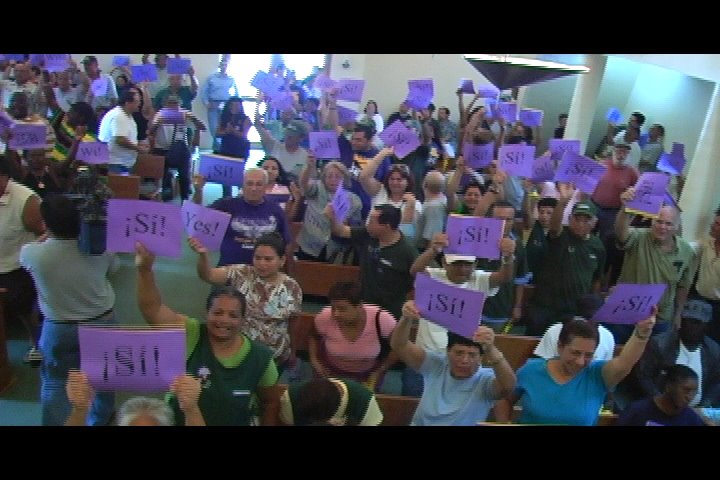
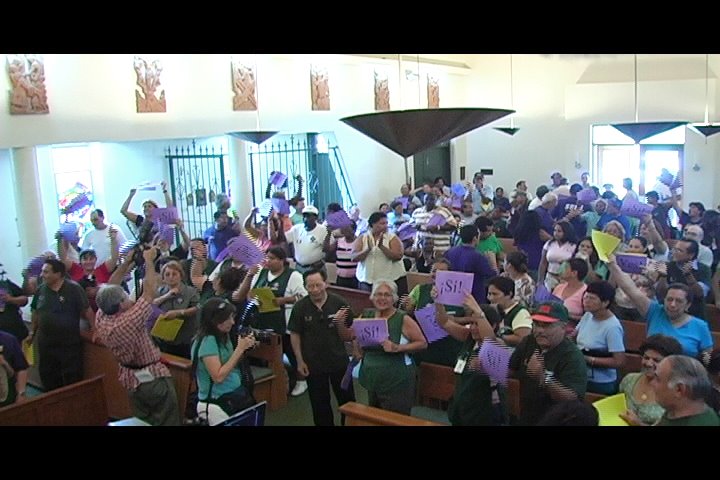
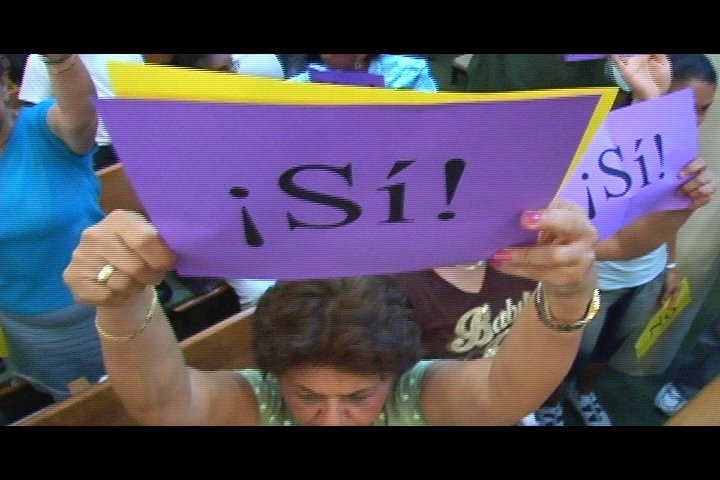
Today at lunchtime, a joyous final chapter was written to the yearlong struggle for a union contract by the UNICCO workers at UM. President of the SEUI Local 11 Rob Schuler explained to a packed Episcopal Church the details of the contract hammered out by UNICCO, the union and the bargaining team of workers. In brief, these are the highlights:
Wages: $0.25 per hour raise on Sep 1, 2006
$0.40 Sep 1, 2007
$0.50 Sep 1, 2008
$0.50 Sep 1, 2009
Health Insurance: any increases in the premium up to 10% to be absorbed by UNICCO. Increases beyond that will trigger a committee to investigate further ways of reducing costs
Personal Days: Increase from 2 to 3 paid personal days
Vacations: 1 year - 1 week
5 years - 2 weeks
10 years - 3 weeks
Holidays: Three extra paid holidays: Christmas Eve, New Year's Eve and the day after Thanksgiving
Funeral Leave: 3 paid days
Seniority: Workers with more years get more benefits
Safety: A committee of workers and management will meet every month to address any safety issues
Union Rights: The union will have the right to post materials, to speak to new hires and to investigate abuses on job time
Immigration: Workers will be allowed time off to deal with immigration issues
Job Security: Basic structures will be put in place to deal with harassment, favoritism and improper dismissal
The workers voted to ratify the contract with great enthusiasm. The energy was amazing and the workers certainly felt they had scored a great victory. As one of them, Julio Ramos, said before the vote, hopefully their job would become one that can lead them out of poverty instead of keeping them in it.
Wages: $0.25 per hour raise on Sep 1, 2006
$0.40 Sep 1, 2007
$0.50 Sep 1, 2008
$0.50 Sep 1, 2009
Health Insurance: any increases in the premium up to 10% to be absorbed by UNICCO. Increases beyond that will trigger a committee to investigate further ways of reducing costs
Personal Days: Increase from 2 to 3 paid personal days
Vacations: 1 year - 1 week
5 years - 2 weeks
10 years - 3 weeks
Holidays: Three extra paid holidays: Christmas Eve, New Year's Eve and the day after Thanksgiving
Funeral Leave: 3 paid days
Seniority: Workers with more years get more benefits
Safety: A committee of workers and management will meet every month to address any safety issues
Union Rights: The union will have the right to post materials, to speak to new hires and to investigate abuses on job time
Immigration: Workers will be allowed time off to deal with immigration issues
Job Security: Basic structures will be put in place to deal with harassment, favoritism and improper dismissal
The workers voted to ratify the contract with great enthusiasm. The energy was amazing and the workers certainly felt they had scored a great victory. As one of them, Julio Ramos, said before the vote, hopefully their job would become one that can lead them out of poverty instead of keeping them in it.
new contract to be voted on today
in today's miami herald:
UM janitors to vote on union today
BY NIALA BOODHOO
nboodhoo@miamiherald.com
University of Miami janitors will vote this afternoon to approve the first union contract with the private school, the Service Employees International Union said.
SEIU said it had reached a tentative agreement with contractor UNICCO Services Company on a new employee contract for the UM workers.
Some janitors held a months-long strike at the university last spring in protest over the right to organize. After nine weeks of the walkout and protests from some students, faculty and clergy -- including a hunger strike -- the university, Unicco and the union reached an agreement in May on how the workers could vote for a union.
A majority of the janitors voted for the union earlier this summer, and negotiations on the contract began soon after.
The vote will be at 1 p.m. today, SEIU said.
Just before the strike began, UM announced it would raise wages for the workers by at least 25 percent.
Details of the contract were not provided, although the union said the tentative agreement provided for higher wages, more vacation time and better healthcare coverage for the 400 workers.
Emboldened by its success at UM, union activists have started organizing campaigns at Nova Southeastern and Florida International Universities.
UM janitors to vote on union today
BY NIALA BOODHOO
nboodhoo@miamiherald.com
University of Miami janitors will vote this afternoon to approve the first union contract with the private school, the Service Employees International Union said.
SEIU said it had reached a tentative agreement with contractor UNICCO Services Company on a new employee contract for the UM workers.
Some janitors held a months-long strike at the university last spring in protest over the right to organize. After nine weeks of the walkout and protests from some students, faculty and clergy -- including a hunger strike -- the university, Unicco and the union reached an agreement in May on how the workers could vote for a union.
A majority of the janitors voted for the union earlier this summer, and negotiations on the contract began soon after.
The vote will be at 1 p.m. today, SEIU said.
Just before the strike began, UM announced it would raise wages for the workers by at least 25 percent.
Details of the contract were not provided, although the union said the tentative agreement provided for higher wages, more vacation time and better healthcare coverage for the 400 workers.
Emboldened by its success at UM, union activists have started organizing campaigns at Nova Southeastern and Florida International Universities.
Tuesday, August 22, 2006
welcome back UM!
it's a grey and rainy day in miami, but it's okay, because our beautiful lawns and beautiful trees need the water -- not that they wouldn't be getting it if it weren't raining, mind you, but this way, hopefully, the university will turn off the sprinklers and let nature take care of itself!
as you admire our spiffed up campus, please keep in mind the men and women who've been putting in a lot of underpaid overtime in the last few weeks to make it look its very best for the beginning of the new year.
now that our UNICCO workers are finally unionized (even these many months later, i cannot write these words without a tinge of disbelief and awe), new contract negotiations are under way. they are taking place as i type. i'll keep you informed.
on a more somber note, i'd like to remember here the mother of pablo rodriguez, one of the ten workers who went on a hunger strike last spring. a couple of weeks ago julia felt ill during a very long shift in 95 degree temperatures. he coworkers had told her to go home or at least take a break, drink some water. but she's always been that way, the hardworking type. she died at the hospital two days later. some of you may remember her: she came to freedom village late in the evening, to spend the night with pablo. pablo's hunger strike was, in large measure, for her: he had already lost his UNICCO job when he started it. our hearts go out to pablo and his family.
and just when you thought the student saga was over, with all of the students accepting the university's handing down of probation, community service (!), and some writing exercises, well, no, it isn't over. last thurday brian lemmerman, a STAND student, sued the university of miami:
even the students who settled are not happy. like many of us, they feel that the proceedings cast a dangerous precedent on freedom of speech on campus. jane connolly, STAND's faculty advisor, has written two impassioned letters about two students whose hearings she was personally involved with. i'm reprinting both of them in full:
august 18:
august 21
as you admire our spiffed up campus, please keep in mind the men and women who've been putting in a lot of underpaid overtime in the last few weeks to make it look its very best for the beginning of the new year.
now that our UNICCO workers are finally unionized (even these many months later, i cannot write these words without a tinge of disbelief and awe), new contract negotiations are under way. they are taking place as i type. i'll keep you informed.
on a more somber note, i'd like to remember here the mother of pablo rodriguez, one of the ten workers who went on a hunger strike last spring. a couple of weeks ago julia felt ill during a very long shift in 95 degree temperatures. he coworkers had told her to go home or at least take a break, drink some water. but she's always been that way, the hardworking type. she died at the hospital two days later. some of you may remember her: she came to freedom village late in the evening, to spend the night with pablo. pablo's hunger strike was, in large measure, for her: he had already lost his UNICCO job when he started it. our hearts go out to pablo and his family.
and just when you thought the student saga was over, with all of the students accepting the
 university's handing down of probation, community service (!), and some writing exercises, well, no, it isn't over. last thurday brian lemmerman, a STAND student, sued the university of miami:
A contract lawsuit filed Thursday in Miami-Dade Circuit Court accuses the University of Miami of unfairly disciplining a student who peacefully demonstrated against the school’s labor policies during a union drive by its janitors.in the miami herald, ana mendendez wrote a scathing piece on the lawsuit and its significance.
The suit, filed by Miami attorneys Lida Rodriguez and Kenneth Kukec, alleges that UM officials railroaded their client, Brian Lemmerman, by flouting the school’s disciplinary procedures and ignoring conflicts of interest. Kukec and Rodriguez claim that UM’s actions constitute a breach of contract.
(read the full article from the daily business review in the first comment).
even the students who settled are not happy. like many of us, they feel that the proceedings cast a dangerous precedent on freedom of speech on campus. jane connolly, STAND's faculty advisor, has written two impassioned letters about two students whose hearings she was personally involved with. i'm reprinting both of them in full:
august 18:
Dear Colleagues,
I met this morning with Katharine Westaway, a graduate student who has been subjected to disciplinary action by the administration. She shared with me her concerns about the status of free speech for students on campus and the significance of this summer's disciplinary actions for students in the future. With Ms Westaway's permission, I share with you her experiences and concerns.
Ms Westaway, an MA student in English, is a senator in the Graduate Student Association. A week before receiving her summons, she was informed by James Fatzinger, Assistant Dean of Students, that she had been selected to serve on the honor council. (Does anyone besides Ms Westaway and me find this appointment ironic, given that she would soon face disciplinary charges at the time and that Mr. Fatzinger would subsequently serve as the judge for her hearing?) Since she would be away from campus for the entire summer and traveling for a portion of it, Ms. Westaway requested that her hearing be postponed until the fall. In this way, she could attend, present witnesses and be judged by a jury of her peers. As with all such requests, she was denied. On 29 June, while attending a program at Johns Hopkins, Ms Westaway participated in a "hearing" telephonically. I use quotation marks as it is clear that very little was actually *heard* by the administration in this or any other case.
Although she was asked if she wished to present witnesses, Ms Westaway wondered just how she would do this in the middle of summer when everyone had scattered and she herself wasn't present. The hearing was presided by Mr. Fatzinger who had also been present at the events where Ms Westaway's alleged violations occurred. Indeed, Mr. Fatzinger took photos of Ms Westaway in front of Ashe that she was asked to identify during her proceeding, as can be seen in a window reflection of Mr. Fatzinger seen in one of these photos. Can anyone say "conflict of interest"? (BTW: in all the photos, Ms Westaway is seated on the ground reading with tape over her mouth. How disorderly and disruptive is that?) The administration's case was presented by Gregory Singleton, Associate Dean of Students and therefore of higher rank than Mr. Fatzinger. It seems odd to have the judge have less power than the prosecutor/investigator, no? The hearing lasted about 45 mins. with a guilty verdict given immediately at the conclusion. Nothing like thoughtful reflection. Ms Westaway's punishment: 2 semesters of probation, 10 hrs. of community service, and a 500-word reflection. The relatively low number of hours of community service was because Mr. Singleton had only seen her in front of Ashe on one day. So, the prosecutor decides the severity of the punishment based on his own eyewitness experience? Again, can anyone say "conflict of interest"? Ms Westaway learned this week in an email from Mr. Singleton that she was late in completing the community service and the reflection. According to the email I saw, he said he sent a letter to her "about July 7" which informed her that the deadline for completion was 29 July. Mind you, he had been told that she was traveling for most of the summer, yet somehow expected her to receive this letter (which she still has not received) and
complete two-thirds of her punishment in three weeks.
Ms Westaway felt that she had virtually no rights in facing these disciplinary proceedings. She was not given a real opportunity to present her case with witnesses before her peers, nor could she have counsel (legal or academic) present to aid her. Quite simply, she was not accorded an impartial, democratic process. She is gravely concerned, as am I, that these hearings will set precedents for future disciplinary actions and that students will routinely be accorded no rights. She asks that we work to prevent this, for the sake of free speech and student rights.
Cordially,
Jane Connolly
august 21
Dear Colleagues,
On 7 July, a "hearing" was held for the disciplinary charges against Alyssa Cundari, a first-year student. With Ms Cundari's permission, I share with you some details from that hearing.
Dayle Wilson, Assistant Dean of Students, presided the case which Gregory Singleton, Associate Dean of Students, investigated and prosecuted. (I have already commented on this uneven power structure elsewhere.) The two witnesses for the prosecution were Richard Walker, Assistant Vice President for Student Affairs, and Keith Fletcher, Director of Butler Volunteer Services. The judge, investigator/prosecutor and two witnesses are all under the Student Affairs umbrella. Ms Cundari presented as witnesses two professors (Frank Palmeri and me) and a graduate student (Shelly Stromoski). I leave it to Dr. Palmeri and Ms Stromoski to tell you of their experiences, if the choose. I will share mine as they supplement Ms. Westaway's experience.
As with other students, Ms Cundari was not allowed to have her hearing postponed until the fall. She returned to Miami the day before the hearing to present her case, finding what witnesses she could in July. I was very impressed with Ms Cundari's composure, maturity and determination against the odds. In response to her questions, I attested to the following:
1. The students all behaved in an orderly fashion. It's hard to call a group of students disorderly when they stand with tape over their mouths and hum "We Shall Overcome," pray, or sit reading books on poverty. I noted that I grew up in Oakland in the 60s, during the rise of the Black Panthers and the Free Speech/Anti War movements, attended Berkeley as an undergraduate and taught at Wisconsin-Madison. I've seen disorderly conduct, and our students were always peaceful, orderly and respectful.
2. The students did not block access to Ashe. Following the initial demonstration, which Charles Steele and many clergy attended, they always made sure that doors were accessible. The administration took the decision to lock those doors, and thus obstructed access. I also witnessed the students helping people (students trying to get advising before registration, potential students and parents, etc.) find their way into Ashe since the administration simply locked the doors and provided no assistance to those wishing to enter to do business there.
3. As an administrator in Ashe at the time of Ms Cundari's alleged misconduct, I attested to the fact that the only complaints I received regarding access and disorderly conduct related to the administration. Faculty were especially disturbed by the way they were treated by security personnel, students found it difficult to get in to see advisors, and everyone (including the cops I spoke to) found the decision to turn on the sprinklers absurd. Indeed, the students were going to move from the entry of Ashe to the lawn until the sprinklers came on and eliminated that possibility.
4. Ms Cundari presented photographs of herself, asking me to identify what she was doing: she was sitting in front of Ashe reading. I further testified that I had seen her on other occasions studying for a Chemistry exam. I don't think that reading and studying are considered disorderly activities on most campuses.
5. I was present when Dean Sandler delivered many of his warnings. He simply told the students that they had to leave, but never said that a warning was final, never gave a deadline, never stated possible consequences. In other words, he never said: "If you do not leave by X hour, the following disciplinary charges will be brought." From my point of view, this was a mistake. I know from my discussions with students during the events in question that they were prepared to leave if they were given a final warning, something that Ms Westaway reconfirmed in my discussion with her last week. They simply weren't given that warning.
Mr. Singleton asked me only two questions. The first was about my familiarity with the students' rights and responsibilities handbook. Yes, and I'm appalled by the way it's being construed. (OK, I only said yes, not wanting to prejudice Ms Cundari's case.) The second was how familiar I was with the office of the Dean of Students and whether I had found that office to be fair in the past. I noted that I have been involved with issues ranging from academic dishonesty to inappropriate conduct, and had dealt almost exclusively with Dean Sandler, whom I always found to be fair. I had little experience with the other members of the office and therefore could not judge their fairness. He asked me no questions about Ms Cundari's conduct.
The independent testimony of two professors and a student did little to persuade Ms Wilson or Mr. Singleton. As in the case of Ms Westaway, Ms Cundari was found guilty at the conclusion of the hearing, with the same punishments as Ms Westaway. I have little doubt that the findings in both cases were predetermined. Do we really want students to be subjected to pro forma justice? If we tolerate this, who will be next?
Cordially,
Jane Connolly
Friday, July 14, 2006
dear colleagues
our colleague jane connolly recently sent this letter to the UM faculty as a commentary on the administration "response" to our letter of june 27. we endorse its content and share in jane's indignation.
Dear Colleagues,
On June 27, 110 faculty submitted a letter in support of our students to Patricia Whitely, Vice President of Student Affairs, and William Sandler, Dean of Students, with copies to President Shalala and Provost LeBlanc. This letter was also posted on http://www.picketline.blogspot.com/ and released to the local press. The Daily Business Review published the letter and offered the UM administration the opportunity to respond. Although the faculty were not given the courtesy of the acknowledgement of the letter, much less a response to its content, the administration did provide a response to DBR as follows:
To the Editor:
While we respect the views expressed by our faculty, it is unfortunate that these particular faculty members have chosen to publicize private, protected information about University of Miami students.
Because the university's principal concern is the well-being of its students, which includes maintaining confidentiality of disciplinary proceedings, it declines the opportunity to discuss the specifics of this matters.
It is worth noting, however, that the faculty letter contains many factual inaccuracies and mischaracterizations with regard to the events to date and is co-signed by only 110 members of the 2,600 faculty body.
The university's actions in this matter have been supported by a number of broad constituencies, including faculty, students, and alumni. The university continues to strongly believe that the students have been treated fairly, responsibly and in accord with its Student Rights and Responsibilities handbook.
University of Miami
The letter makes a number of false claims which must be addressed.
1. The purported signatory of the letter is "University of Miami." It is odd that anyone in the administration believes that s/he is the "University of Miami." The closing sentence also reveals that the author believes that s/he speaks for the entire university: "The university continues to strongly believe that the students have been treated fairly, responsibly and in accord with its Student Rights and Responsibilities handbook." This is, quite simply, not the case. The university is comprised of its students, faculty, staff, administrators and alumni. Minimally, the 110 faculty who signed the letter and scores of students who have been accused or who support the accused do not believe that the students have been treated fairly. Conversations with a large number of staff and some administrators, both vulnerable entities in this context, show that they do not share this view. Nor does any of the alumni we have spoken to. The 110 faculty signatories did not claim to be the University of Miami, and we ask in the future that the administration refrain from such misleading statements.
2. The administration asserts that the release of this letter to the press violates "private, protected information" about the students. This claim is sheer nonsense. Since no student's identity was revealed, no confidentiality was infringed. In addition, the students themselves have spoken directly to the press about the charges and proceedings. They have also authorized some of the signatories to do so, as well as saying that information, including their identities, may be posted on picketline. The administration's claim of a violation of confidentiality by faculty is the height of hypocrisy, given that the administration violated the students' right to privacy (and hence, the Buckley amendment) by delivering summonses to some students in class, in front of their colleagues and faculty.
3. The administration claims that the letter contains "factual inaccuracies and mischaracterizations" but declines to indicate any of these. We stand behind the statements in the letter, which are based on information provided by the accused students and their lawyers (some of whom are UM faculty), our own discussions with UM administrators, and our own eyewitness experience of the events.
4. The administration's declaration that "The university's actions in this matter have been supported by a number of broad constituencies, including faculty, students, and alumni" is bogus. While some from each group *may* have supported the administration's actions during the strike, very few in any of these groups even *know* of the administration's actions with regard to disciplining the students, most especially because these actions are being taken in the summer when faculty and students are largely absent from campus. This, in fact, is a large part of the complaint of the accused students and the faculty signatories: the administration has refused to postpone the proceedings until the fall when the students could have a fair hearing before a panel including students and with student and faculty witnesses and faculty advisors to support their cases.
5. The administration shows no respect for the signatories, who are "only 110 members of the 2,600 faculty body." Only? The fact that as many as 110 faculty signed the letter in the middle of the summer is astonishing. Either the author of the letter wishes to denigrate the 110 signatories or, as an administrator, doesn't realize how astonishing it is that 110 faculty could even be found in the middle of the summer to consider signing a letter. It is also worth noting that, unlike the administration, we have no means to communicate with all faculty across the campuses. We can only communicate to that portion of the faculty (fewer than 600) who are members of this list.
Cordially,
Jane Connolly
Professor of Spanish
Dear Colleagues,
On June 27, 110 faculty submitted a letter in support of our students to Patricia Whitely, Vice President of Student Affairs, and William Sandler, Dean of Students, with copies to President Shalala and Provost LeBlanc. This letter was also posted on http://www.picketline.blogspot
To the Editor:
While we respect the views expressed by our faculty, it is unfortunate that these particular faculty members have chosen to publicize private, protected information about University of Miami students.
Because the university's principal concern is the well-being of its students, which includes maintaining confidentiality of disciplinary proceedings, it declines the opportunity to discuss the specifics of this matters.
It is worth noting, however, that the faculty letter contains many factual inaccuracies and mischaracterizations with regard to the events to date and is co-signed by only 110 members of the 2,600 faculty body.
The university's actions in this matter have been supported by a number of broad constituencies, including faculty, students, and alumni. The university continues to strongly believe that the students have been treated fairly, responsibly and in accord with its Student Rights and Responsibilities handbook.
University of Miami
The letter makes a number of false claims which must be addressed.
1. The purported signatory of the letter is "University of Miami." It is odd that anyone in the administration believes that s/he is the "University of Miami." The closing sentence also reveals that the author believes that s/he speaks for the entire university: "The university continues to strongly believe that the students have been treated fairly, responsibly and in accord with its Student Rights and Responsibilities handbook." This is, quite simply, not the case. The university is comprised of its students, faculty, staff, administrators and alumni. Minimally, the 110 faculty who signed the letter and scores of students who have been accused or who support the accused do not believe that the students have been treated fairly. Conversations with a large number of staff and some administrators, both vulnerable entities in this context, show that they do not share this view. Nor does any of the alumni we have spoken to. The 110 faculty signatories did not claim to be the University of Miami, and we ask in the future that the administration refrain from such misleading statements.
2. The administration asserts that the release of this letter to the press violates "private, protected information" about the students. This claim is sheer nonsense. Since no student's identity was revealed, no confidentiality was infringed. In addition, the students themselves have spoken directly to the press about the charges and proceedings. They have also authorized some of the signatories to do so, as well as saying that information, including their identities, may be posted on picketline. The administration's claim of a violation of confidentiality by faculty is the height of hypocrisy, given that the administration violated the students' right to privacy (and hence, the Buckley amendment) by delivering summonses to some students in class, in front of their colleagues and faculty.
3. The administration claims that the letter contains "factual inaccuracies and mischaracterizations" but declines to indicate any of these. We stand behind the statements in the letter, which are based on information provided by the accused students and their lawyers (some of whom are UM faculty), our own discussions with UM administrators, and our own eyewitness experience of the events.
4. The administration's declaration that "The university's actions in this matter have been supported by a number of broad constituencies, including faculty, students, and alumni" is bogus. While some from each group *may* have supported the administration's actions during the strike, very few in any of these groups even *know* of the administration's actions with regard to disciplining the students, most especially because these actions are being taken in the summer when faculty and students are largely absent from campus. This, in fact, is a large part of the complaint of the accused students and the faculty signatories: the administration has refused to postpone the proceedings until the fall when the students could have a fair hearing before a panel including students and with student and faculty witnesses and faculty advisors to support their cases.
5. The administration shows no respect for the signatories, who are "only 110 members of the 2,600 faculty body." Only? The fact that as many as 110 faculty signed the letter in the middle of the summer is astonishing. Either the author of the letter wishes to denigrate the 110 signatories or, as an administrator, doesn't realize how astonishing it is that 110 faculty could even be found in the middle of the summer to consider signing a letter. It is also worth noting that, unlike the administration, we have no means to communicate with all faculty across the campuses. We can only communicate to that portion of the faculty (fewer than 600) who are members of this list.
Cordially,
Jane Connolly
Professor of Spanish
Wednesday, July 12, 2006
Check out this piece by Mary Beth Maxwell, from American Rights at Work. The piece appears in Political Affairs.
U.S. Labor Law is Broken
If you ask most people in America why there are fewer members of unions, they have ready answers. They think it’s because of technology or because manufacturing jobs have left or it’s due to globalization and changes in the economy. They agree how important unions were in the old days, but wonder if maybe they just don’t fit anymore—maybe that’s why fewer workers have unions today. There are three answers to that question that most people in America don’t know—and need to know—that explain why so few workers have unions.
The first is that employer interference with workers making a choice about a union is completely off the charts. At American Rights at Work, we crunched the government’s own numbers from the National Labor Relations Board (NLRB) and demonstrated that literally every 23 minutes in the United States—in the United States of America—someone is illegally discriminated against or fired for trying to exercise their rights at work. That’s really an outrage in a democracy. There is a level of lawlessness in the U.S. workplace in terms of firings and surveillance and intimidation that I think would stun most people if they knew about it. We commissioned a report from the University of Illinois at Chicago that found 30 percent of employers fire somebody illegally during organizing campaigns. Further, 49 percent of employers threatened to shut down the worksite if people were to vote for forming a union, and 82 percent of those employers actually hire high-priced union-busting consultants to coach them in how to defeat those campaigns.
Second, most people in America have no idea that union-busting is a massive, for-profit industry—it’s simply not “some workers want a union and some don’t.” Workers are up against hired guns, coaching managers and middle-managers and co-workers on how to defeat a union organizing campaign. [cont'd]
U.S. Labor Law is Broken
If you ask most people in America why there are fewer members of unions, they have ready answers. They think it’s because of technology or because manufacturing jobs have left or it’s due to globalization and changes in the economy. They agree how important unions were in the old days, but wonder if maybe they just don’t fit anymore—maybe that’s why fewer workers have unions today. There are three answers to that question that most people in America don’t know—and need to know—that explain why so few workers have unions.
The first is that employer interference with workers making a choice about a union is completely off the charts. At American Rights at Work, we crunched the government’s own numbers from the National Labor Relations Board (NLRB) and demonstrated that literally every 23 minutes in the United States—in the United States of America—someone is illegally discriminated against or fired for trying to exercise their rights at work. That’s really an outrage in a democracy. There is a level of lawlessness in the U.S. workplace in terms of firings and surveillance and intimidation that I think would stun most people if they knew about it. We commissioned a report from the University of Illinois at Chicago that found 30 percent of employers fire somebody illegally during organizing campaigns. Further, 49 percent of employers threatened to shut down the worksite if people were to vote for forming a union, and 82 percent of those employers actually hire high-priced union-busting consultants to coach them in how to defeat those campaigns.
Second, most people in America have no idea that union-busting is a massive, for-profit industry—it’s simply not “some workers want a union and some don’t.” Workers are up against hired guns, coaching managers and middle-managers and co-workers on how to defeat a union organizing campaign. [cont'd]
Friday, June 30, 2006
The administration's "response" to the faculty letter
Since it looks like the UM administration prefers to publish its response to the faculty letter in a newspaper rather than responding directly to the faculty, we trekked to Barnes & Noble and bought a copy of the Daily Business Review. Here is the administration's response:
To the Editor:The Daily Business Review is available online, but you need a subscription to read its content. To find a place near you where the Review is sold, click here. If you have comments and suggestions, click the "comment" link at the bottom of this post, then click "other", write whatever name you want to go by, ignore the webpage space, and write your heart out.
While we respect the views expressed by our faculty, it is unfortunate that these particular faculty members have chosen to publicize private, protected information about University of Miami students.
Because the university's principal concern is the well-being of its students, which includes maintaining confidentiality of disciplinary proceedings, it declines the opportunity to discuss the specifics of this matters.
It is worth noting, however, that the faculty letter contains many factual inaccuracies and mischaracterizations with regard to the events to date and is co-signed by only 110 members of the 2,600 faculty body.
The university's actions in this matter have been supported by a number of broad constituencies, including faculty, students, and alumni. The university continues to strongly believe that the students have been treated fairly, responsibly and in accord with its Student Rights and Responsibilities handbook.
University of Miami
Faculty's letter to the UM Administration printed in today's Daily Business Review
The UM faculty's letter to the administration, protesting the latter's treatment of the students being disciplined for their role in supporting the janitors, appears in the Daily Business Review, along with a response from the administration. Unfortunately, you have to be a paid subscriber to read these, so unless the administration actually replies to the letter we sent them, we won't know what they're thinking. (If you haven't already, you can read the faculty letter here.)
Thanks to the Daily Business Review for providing the space for this debate.
Thanks to the Daily Business Review for providing the space for this debate.
Sunday, May 14, 2006
stand up for what you believe
At the Arts and Sciences commencement, President Donna Shalala said in her closing comments: "Make your mark boldly. ... Don't be afraid to stand up for what you believe and to support others who do likewise." Maybe the STAND students under investigation and their lawyers should make the case that they were just following President Shalala's instructions, ante literam.
Former Secretary of State Madeleine Albright told the students that "To run from risk is to run from life." One of life's greatest challenges is "the use we make of the time we have." "Many have the intention of acting on bold plans," but wait until they graduate, pay off the mortgage, and keep waiting until it's too late. She encouraged students not to wait, to dedicate themselves to freedom and human rights, and to use their gifts "to help, heal and teach." Isn't Albright's advice exactly what the students under threat of disciplinary action have done?
Tanya Aquino and Amancio Paradela (the latter is subject to disciplinary action; the former has not received a summons but was one of STAND leaders and a student hunger striker) walked. Amancio, bless him, hugged Donna Shalala.
(You can hear all the commencement speeches and see, among other things, Amancio hug President Shalala in the webcasts provided here).
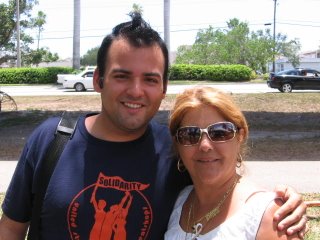 Amancio, holding hunger striking janitor Elsa Rodriguez, on the day after UNICCO and the SEIU settled, handing the janitors a resounding victory.
Former Secretary of State Madeleine Albright told the students that "To run from risk is to run from life." One of life's greatest challenges is "the use we make of the time we have." "Many have the intention of acting on bold plans," but wait until they graduate, pay off the mortgage, and keep waiting until it's too late. She encouraged students not to wait, to dedicate themselves to freedom and human rights, and to use their gifts "to help, heal and teach." Isn't Albright's advice exactly what the students under threat of disciplinary action have done?
Tanya Aquino and Amancio Paradela (the latter is subject to disciplinary action; the former has not received a summons but was one of STAND leaders and a student hunger striker) walked. Amancio, bless him, hugged Donna Shalala.
(You can hear all the commencement speeches and see, among other things, Amancio hug President Shalala in the webcasts provided here).
 Amancio, holding hunger striking janitor Elsa Rodriguez, on the day after UNICCO and the SEIU settled, handing the janitors a resounding victory.
Friday, May 12, 2006
A Bittersweet Graduation Day
A powerful letter sent by a member of the UM faculty to some of the editors of this blog. The letter is slightly edited and the name of its author is withheld for confidentiality reasons. Thank you to the writer for allowing us to post this on picketline.
The immigrant protests of last week have taught many of us much about the power of collective action. The trends of late in this country (e.g. wanting to turn undocumented immigrants into felons; trying to strike from the Voting Rights Act the provision that allows for bilingual ballots; the list is endless) show that the only way to get our leaders to hear the voices of the powerless is to gather and expresses ourselves collectively.
For those graduating [on May 12 at the University of Miami], they have much to be proud of and should celebrate this momentous occasion. However, not all students might be allowed to enjoy this kind of event in the future. That's because a group of students who supported the striking janitors this semester are being threatened with charges of expulsion for their peaceful protests. Inevitably, this sends the message to future student activists to keep their mouths shut. If they don't, they may join the "blacklist" of student "agitators" (as UM would call them).
As a social scientist, many of my classes draw attention to the plight of the powerless and leave students wondering, how do we bring about social change? Never have I witnessed what I did this semester: a group of students took their educations a step further by not just feeling bad about the poverty-wages of janitors, but actually aligning with them to get their voices heard. In my view, these students have learned. They should get full honors when graduating. They took the knowledge that they have acquired in the classroom outside of the ivory tower and selflessly put it to use. Yet, how is the university administration rewarding them? With the threat of expulsion. And what is the administration's message to the community supporting them? A full-page ad in the Miami Herald the day before graduation discouraging any sympathizer from expressing their solidarity.
I think we faculty can learn a lot from our students. Among these lessons, I've learned that courage is contagious. I also have been reminded that we should practice what we preach. What good am I as an educator if I can't learn this from my students? What good is a university as a place of higher learning when the administration admonishes those who try to live out what they have learned?
To the graduating students and their families, I express my wholehearted congratulations. To the university administration, I hope you will listen to the not-so-powerful in the community and cease your attempts to squelch free speech.
The immigrant protests of last week have taught many of us much about the power of collective action. The trends of late in this country (e.g. wanting to turn undocumented immigrants into felons; trying to strike from the Voting Rights Act the provision that allows for bilingual ballots; the list is endless) show that the only way to get our leaders to hear the voices of the powerless is to gather and expresses ourselves collectively.
For those graduating [on May 12 at the University of Miami], they have much to be proud of and should celebrate this momentous occasion. However, not all students might be allowed to enjoy this kind of event in the future. That's because a group of students who supported the striking janitors this semester are being threatened with charges of expulsion for their peaceful protests. Inevitably, this sends the message to future student activists to keep their mouths shut. If they don't, they may join the "blacklist" of student "agitators" (as UM would call them).
As a social scientist, many of my classes draw attention to the plight of the powerless and leave students wondering, how do we bring about social change? Never have I witnessed what I did this semester: a group of students took their educations a step further by not just feeling bad about the poverty-wages of janitors, but actually aligning with them to get their voices heard. In my view, these students have learned. They should get full honors when graduating. They took the knowledge that they have acquired in the classroom outside of the ivory tower and selflessly put it to use. Yet, how is the university administration rewarding them? With the threat of expulsion. And what is the administration's message to the community supporting them? A full-page ad in the Miami Herald the day before graduation discouraging any sympathizer from expressing their solidarity.
I think we faculty can learn a lot from our students. Among these lessons, I've learned that courage is contagious. I also have been reminded that we should practice what we preach. What good am I as an educator if I can't learn this from my students? What good is a university as a place of higher learning when the administration admonishes those who try to live out what they have learned?
To the graduating students and their families, I express my wholehearted congratulations. To the university administration, I hope you will listen to the not-so-powerful in the community and cease your attempts to squelch free speech.
Excerpt from a Letter from Professor Roger Kanet to President Shalala Concerning Disciplinary Action Against Students
 I will not raise the issues associated with questions of free speech and of "acting on one's convictions." Let me merely note that, if Provost LeBlanc and you are serious about upgrading the academic quality of future classes of UM undergraduates, the number of students able and willing to think for themselves is likely to increase. What happens now with regard to the students under "indictment" will set the tone for the future and, no doubt, influence the decisions of precisely some of those potential future students
 The students have now had the possibility of draconian measures hanging over their heads for more than a month. I recognize that the university has procedures for dealing with them. However, both of us know that flexibility exists for handling issues of this type and that ultimately, as President of the University of Miami, you can influence those procedures. I sincerely hope that you live up to the principles implied in your call to the graduates to act on their convictions.
Letter from Professor Hugh Thomas to UM Faculty Concerning Disciplinary Action Against the Students
 Dear Colleagues,
Many of you will have seen yesterday’s advertisement in the Miami Herald condemning a planned protest of today’s graduation. Although I am a strong supporter of unionization efforts and of the students who have supported it, I was never in favor of the protest, partly for some of the reasons the ad stated. I was relieved to learn yesterday that the protest had been cancelled at the request of the students whom it was intended to support. Nevertheless, this extremely expensive advertisement seems to me to form part of a troubling effort on the part of the administration to intimidate student attempts to support the unionization effort.
Since the last week of April, approximately 20 students received Official Notices to appear before Dean Singleton. The notices indicated that they were being investigated for “major violations” (a technical term) which could possibly lead to suspension or expulsion. When union representatives asked for amnesty for the students as part of the negotiated settlement on May 1, they were told that was not on the table. When the students appeared before Dean Singleton, each of them represented by a lawyer working pro bono, they were advised that the charges related to violations of university rules on disorderly conduct and failure to comply with the university’s requests or orders. They were also asked to identify pictures of themselves or others in pictures of demonstrations. On the advice of their attorneys they said nothing. A few days ago, the attorneys representing the students asked for a meeting with President Shalala. Their request was rebuffed and they were referred to a private law firm hired by the university.
Many of the students involved are members of STAND, the same group that President Shalala praised in a letter for telling “outside agitators” they were not welcome on campus. This letter came out around the same time the administration banned STAND from holding events on campus. At the last faculty senate meeting, in reference to the charges against the students, President Shalala stated that they were not about free speech. I wonder. Peaceful protests, such as the one called today in support of the students, are an expression of free speech, whatever one may think of the causes they support. A peaceful protest counts as free speech evenif one doubts the propriety of holding it during a festive celebration such as graduation. I have no doubt that the students opposing the protest in yesterday’s Herald Advertisement were freely expressing their own understandable views. I doubt, however, that they organized and paid for the ad; the Miami Herald apparently charges $11,466 for such an ad for not-for-profit institutions. Although I opposed demonstrating on the day of graduation in the first place, I can’t avoid the suspicion that the administration was employing considerable resources to try to bully those who disagree with it by a very public condemnation of the protest that did not mention at all what the protest was about. At the graduate convocation, yesterday, President Shalala urged students to act on their convictions. One of my faculty colleagues who was there commented that “She didn’t add: And if I disagree with you, I’ll threaten you with suspension or expulsion.”
The processes against the students remain in progress. Since at this point the charges remain quite nebulous, it is hard to respond to them, and of course the administration will not discuss ongoing investigations, which in the abstract is a reasonable enough stance. What some of us fear, however, is that the administration is waiting until everyone goes away for the summer in order to lower the hammer at a time when people can hardly react. Suspending or expelling activist students would certainly have a chilling effect on student activism and free speech in the future. At this point, I would simply like to ask all of you on the faculty to keep an eye on this issue and to make sure that the administration treats our students fairly. Hopefully, it will do so, but as a faculty we have a responsibility not just to hope, but make sure.
Hugh Thomas
Department of History
Thursday, May 11, 2006
Rally tomorrow in support of UM students postponed indefinitely
At the request of the students involved, a rally planned by community activists for tomorrow, May 12th to support UM students under threat of disciplinary action by the university has been postponed indefinitely.
Information pertaining to the students' cases will be posted here as it becomes available.
Information pertaining to the students' cases will be posted here as it becomes available.
Tuesday, May 09, 2006
Message in a Bottle
A very welcome letter in today's Herald from David Bonior. I believe that, despite our best efforts, this is the first time the Herald has printed, in any format, the information about the deficiencies in NLRB elections. Better late than never.
Two other items from the Herald in recent days: a great wrap-up column from Ana Menendez, reflecting on the whole struggle. And a piece from the business section discussing the future.
And this from the Coral Gables Gazette, dealing especially with the student disciplinary hearings.
Re Michael Putney's May 3 Other Views column, UM janitors' strike -- Shalala: 1; union: 0: The headline suggests that Putney doesn't understand why University of Miami workers walked off the job. Of course they want a better wage and some health coverage. But more than that they want something that can't be taken away or slashed a year from now, a voice at work -- a union. And now they will have a fair shot at it through a card check, the process that Unicco, the UM subcontractor involved, has agreed to all across the country.
The union recognition process for which UM and Unicco held out is an increasingly discredited procedure. The current process administered by the National Labor Relations Board is widely acknowledged to be a broken system that invites abuse. Recent research by American Rights at Work found that in the weeks leading up to an election, 30 percent of employers faced with organizing
drives fire pro-union workers, and 51 percent coerce workers into opposing unions with bribery or favoritism.
Putney referred to the janitors as ''unsophisticated immigrant workers'' and alleged that the media were somehow to blame for buying into a ''respect/justice motif.'' The disrespect is breathtaking. Seeking decent wages for honest work is not a zero-sum game where the workers gain at the contractor's expense or the university triumphs over its workers.
UM, Unicco and the janitors all deserve praise for coming together and agreeing to terms that are fair and grant the workers a voice on the job.
DAVID BONIOR, chair, American Rights at Work, Washington, D.C.
Two other items from the Herald in recent days: a great wrap-up column from Ana Menendez, reflecting on the whole struggle. And a piece from the business section discussing the future.
And this from the Coral Gables Gazette, dealing especially with the student disciplinary hearings.
Sunday, May 07, 2006
SHEER JOY
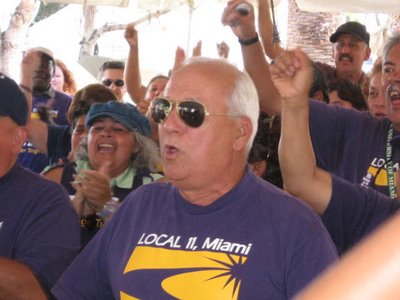
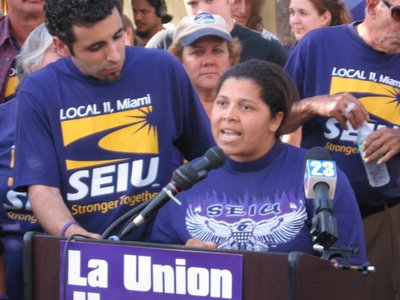
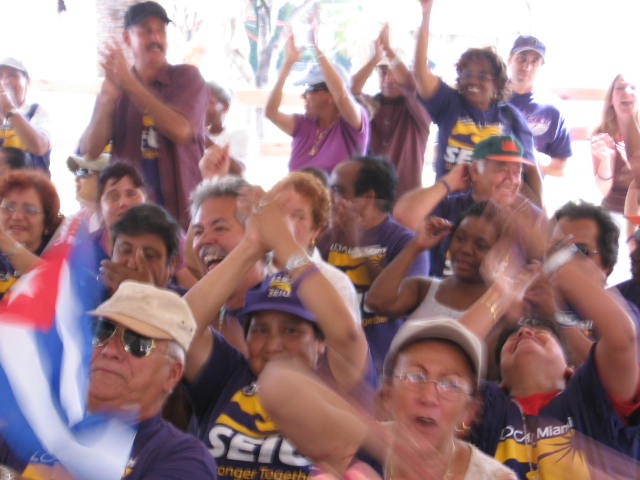
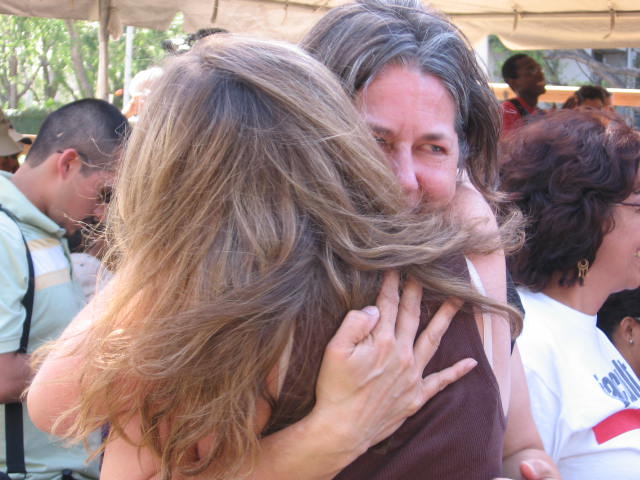
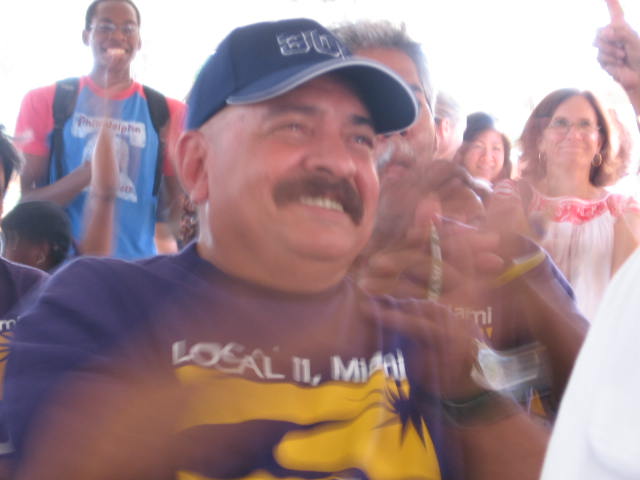
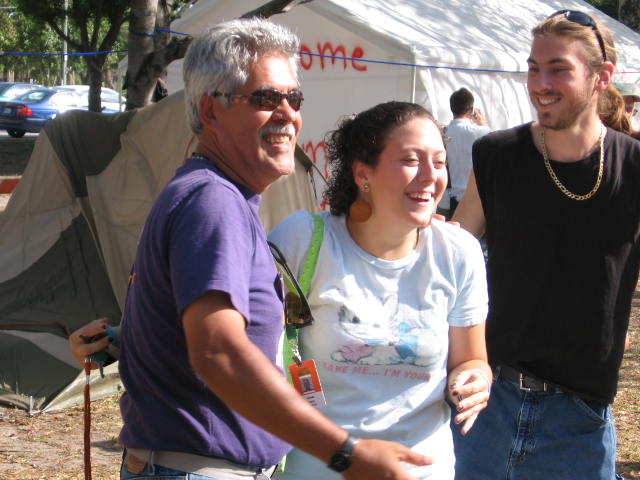
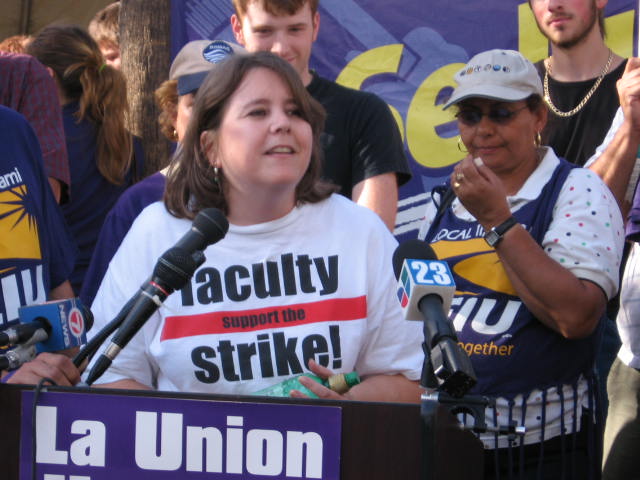
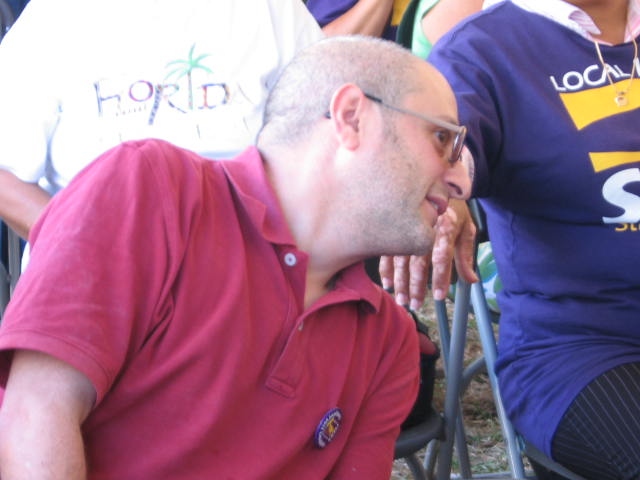
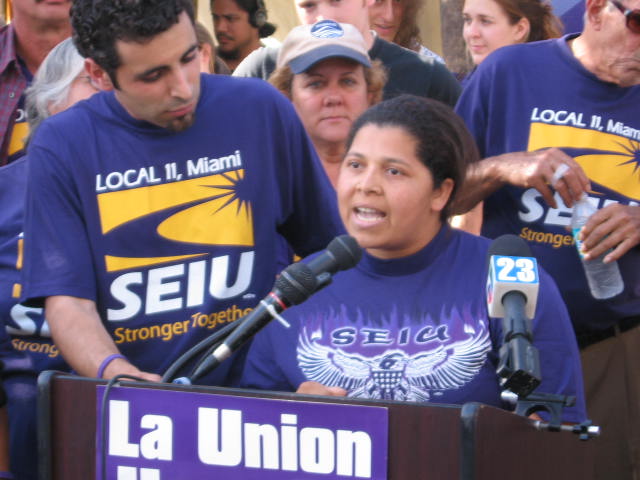
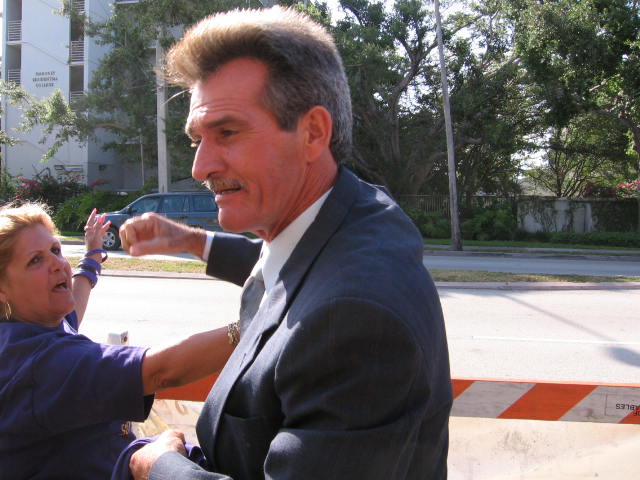
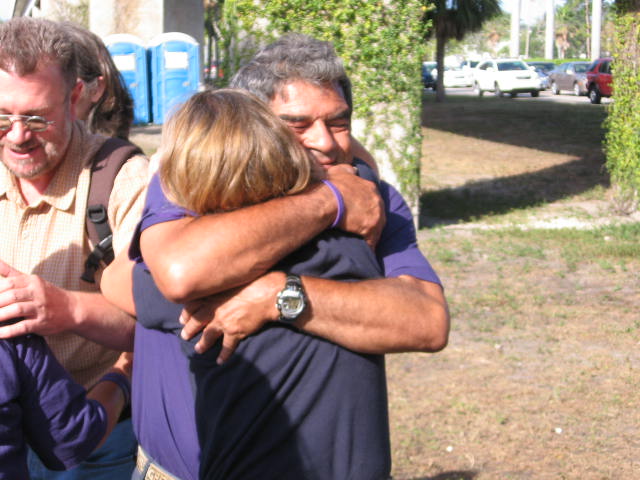
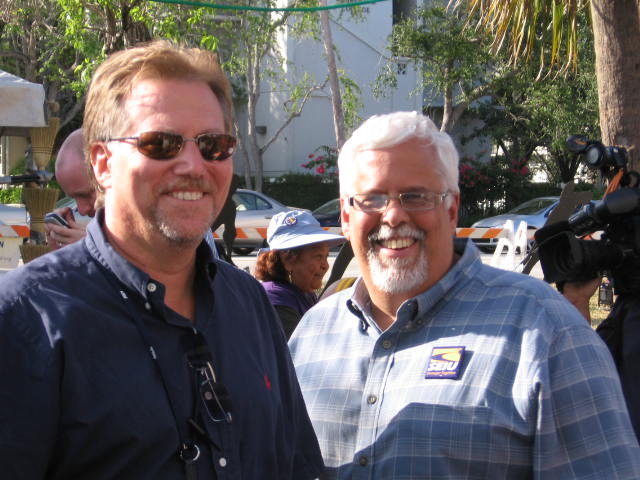
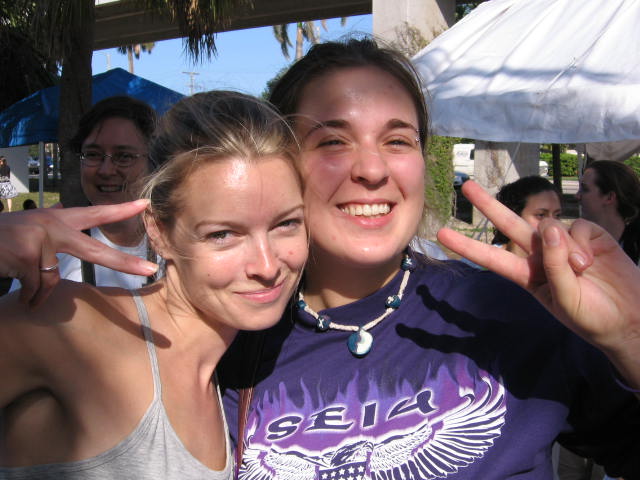
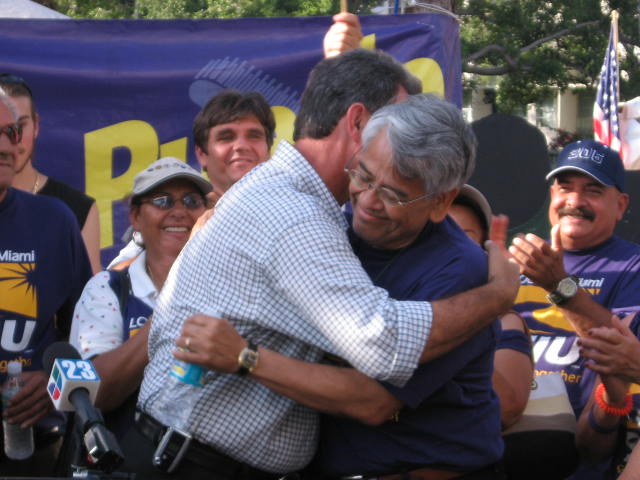
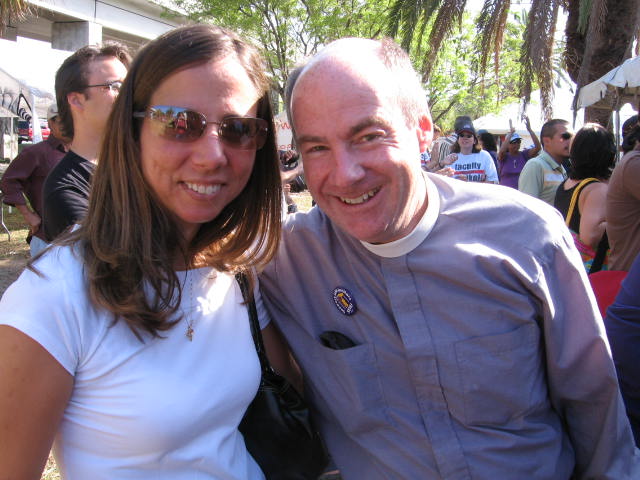
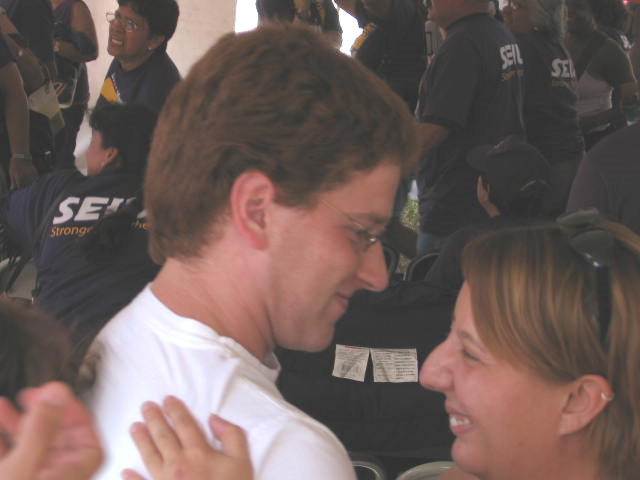
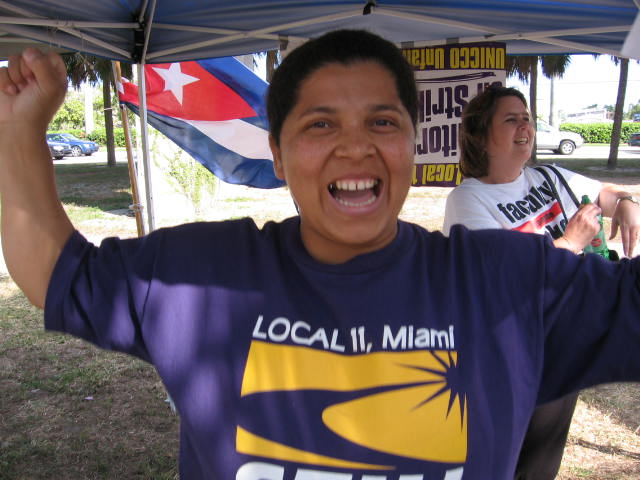
this has been long coming, considering that the events to which these pictures refer took place a whole week ago!!!! but my computer crashed, and i am the one who took the pictures, so....
... ladies and gents, enjoy these pictures and share the joy of sweet victory with the janitors, the students, the faculty, and the community who fought for justice and WON at the university of miami in the year 2006! remember you were there: you are part of history.










... ladies and gents, enjoy these pictures and share the joy of sweet victory with the janitors, the students, the faculty, and the community who fought for justice and WON at the university of miami in the year 2006! remember you were there: you are part of history.













Subscribe to:
Posts (Atom)