Friday, May 12, 2006

Excerpt from a Letter from Professor Roger Kanet to President Shalala Concerning Disciplinary Action Against Students

I will not raise the issues associated with questions of free speech and of "acting on one's convictions." Let me merely note that, if Provost LeBlanc and you are serious about upgrading the academic quality of future classes of UM undergraduates, the number of students able and willing to think for themselves is likely to increase. What happens now with regard to the students under "indictment" will set the tone for the future and, no doubt, influence the decisions of precisely some of those potential future students

The students have now had the possibility of draconian measures hanging over their heads for more than a month. I recognize that the university has procedures for dealing with them. However, both of us know that flexibility exists for handling issues of this type and that ultimately, as President of the University of Miami, you can influence those procedures. I sincerely hope that you live up to the principles implied in your call to the graduates to act on their convictions.
Letter from Professor Hugh Thomas to UM Faculty Concerning Disciplinary Action Against the Students

Dear Colleagues,

Many of you will have seen yesterday’s advertisement in the Miami Herald condemning a planned protest of today’s graduation. Although I am a strong supporter of unionization efforts and of the students who have supported it, I was never in favor of the protest, partly for some of the reasons the ad stated. I was relieved to learn yesterday that the protest had been cancelled at the request of the students whom it was intended to support. Nevertheless, this extremely expensive advertisement seems to me to form part of a troubling effort on the part of the administration to intimidate student attempts to support the unionization effort.

Since the last week of April, approximately 20 students received Official Notices to appear before Dean Singleton. The notices indicated that they were being investigated for “major violations” (a technical term) which could possibly lead to suspension or expulsion. When union representatives asked for amnesty for the students as part of the negotiated settlement on May 1, they were told that was not on the table. When the students appeared before Dean Singleton, each of them represented by a lawyer working pro bono, they were advised that the charges related to violations of university rules on disorderly conduct and failure to comply with the university’s requests or orders. They were also asked to identify pictures of themselves or others in pictures of demonstrations. On the advice of their attorneys they said nothing. A few days ago, the attorneys representing the students asked for a meeting with President Shalala. Their request was rebuffed and they were referred to a private law firm hired by the university.

Many of the students involved are members of STAND, the same group that President Shalala praised in a letter for telling “outside agitators” they were not welcome on campus. This letter came out around the same time the administration banned STAND from holding events on campus. At the last faculty senate meeting, in reference to the charges against the students, President Shalala stated that they were not about free speech. I wonder. Peaceful protests, such as the one called today in support of the students, are an expression of free speech, whatever one may think of the causes they support. A peaceful protest counts as free speech evenif one doubts the propriety of holding it during a festive celebration such as graduation. I have no doubt that the students opposing the protest in yesterday’s Herald Advertisement were freely expressing their own understandable views. I doubt, however, that they organized and paid for the ad; the Miami Herald apparently charges $11,466 for such an ad for not-for-profit institutions. Although I opposed demonstrating on the day of graduation in the first place, I can’t avoid the suspicion that the administration was employing considerable resources to try to bully those who disagree with it by a very public condemnation of the protest that did not mention at all what the protest was about. At the graduate convocation, yesterday, President Shalala urged students to act on their convictions. One of my faculty colleagues who was there commented that “She didn’t add: And if I disagree with you, I’ll threaten you with suspension or expulsion.”

The processes against the students remain in progress. Since at this point the charges remain quite nebulous, it is hard to respond to them, and of course the administration will not discuss ongoing investigations, which in the abstract is a reasonable enough stance. What some of us fear, however, is that the administration is waiting until everyone goes away for the summer in order to lower the hammer at a time when people can hardly react. Suspending or expelling activist students would certainly have a chilling effect on student activism and free speech in the future. At this point, I would simply like to ask all of you on the faculty to keep an eye on this issue and to make sure that the administration treats our students fairly. Hopefully, it will do so, but as a faculty we have a responsibility not just to hope, but make sure.

Hugh Thomas
Department of History

Thursday, May 11, 2006

Rally tomorrow in support of UM students postponed indefinitely

At the request of the students involved, a rally planned by community activists for tomorrow, May 12th to support UM students under threat of disciplinary action by the university has been postponed indefinitely.

Information pertaining to the students' cases will be posted here as it becomes available.

Miami Mothers Urge Dole Fresh Flowers to Keep its Promises on Mother's Day

On Friday, May 12th at noon, an alliance of mothers, faith leaders and community members will rally in front of Dole Fresh Flowers headquarters at 10055 NW 12th Street in MIAMI to urge the company to keep its promise to negotiate with flower workers in Colombia, most of whom are women and face dangerous working conditions every day.

Backed by a wall of paper flowers representing the 700 workers at the Dole-owned Splendor plantation in Colombia, a delegation of local mothers will present a Mother's Day card to the company in support of the women flower workers, 70% of whom are also mothers.

"Women in the United States can have a powerful voice on issues impacting women around the world. As consumers we have a responsibility to speak up when there is injustice," said Sophie Brion, Director of the Women's Advocacy Project, an initiative of Women's Fund of Miami-Dade. "We are joining together because our voices can change the way women are treated around the world."

In November 2004, flower workers at the Splendor plantations formed the first independent and democratic union at Dole's operations in Colombia. During the peak seasons around Valentine's and Mother's Days, employees at the Splendor plantation say they work up to 80 hours per week, without overtime pay, and earn less than $180 per month. Colombian flower workers are often terminated or do not have their job contracts renewed if they become pregnant while employed at the plantation, according to the union.

"Together, we can shine a light on the negative actions of U.S.-based companies. On May 12th we will raise our voices in support of Colombian flower workers' efforts to win fair wages, workplace safety, and the right to know that getting pregnant does not mean getting fired. These are basic rights that any employee should have," said Carolina Delgado, membership director of South Florida Jobs with Justice.

To date, Dole Fresh Flowers denies any wrong-doing in Colombia, according to the union, and despite a September 2005 commitment to negotiate with union representatives, no progress has been made to consider an election by workers to determine union representation. Miami-based Dole Fresh Flowers is the largest employer of flower workers and owns 20% of the Colombian flower industry.

The rally is organized by a coalition of groups consisting of South Florida Jobs with Justice, Unite for Dignity and Women's Fund of Miami-Dade-Women's Advocacy Project and is endorsed by International Labor Rights Fund.

South Florida Jobs with Justice is a non-profit coalition of nearly 40 academic, worker and religious organizations and over 4,500 individual members who strive to improve the rights of working families. Jobs with Justice uses public education and persuasion to assist workers in the South Florida region.

Unite for Dignity is an immigrant workers' rights organization building new leaders to fight for improved conditions in workplaces and community in South Florida.

Women's Fund of Miami-Dade is a catalyst for social change, creating a community where all women and girls reach their full potential. The Fund's Women's Advocacy Project works to amplify the voices of women and girls in Miami-Dade, particularly immigrant women, and those who are survivors of domestic violence.

Wednesday, May 10, 2006

This is what NLRB elections mean

An article from today's New York Times:

Court Rules Pork Processor Broke Law in Fighting Union
By STEVEN GREENHOUSE
Published: May 10, 2006

Nearly nine years after a unionization drive failed, a federal appeals court has ruled that the Smithfield Packing Company repeatedly broke the law in battling unionization at its giant pork-processing plant in Tar Heel, N.C.

In a decision released on Monday, the United States Court of Appeals for the District of Columbia Circuit upheld a broad cease-and-desist order that the National Labor Relations Board issued against Smithfield in 2004 in response to complaints by the United Food and Commercial Workers. The union accused Smithfield of illegally skewing a 1997 election by intimidating and firing workers.

Concluding that Smithfield had engaged in "intense and widespread coercion," the appeals court upheld the labor board's ruling that one worker was improperly coerced when he was ordered to stamp hogs with a "Vote No" stamp.
The appeals court ordered Smithfield to reinstate four fired workers, one of whom was beaten by the plant's police the day of the election. The court concurred with the labor board's findings that Smithfield's managers were not credible when they insisted that the four workers were fired for reasons other than their support for the union.
The circuit court noted that Smithfield had illegally confiscated union materials, spied on workers' union activities, threatened to fire workers who voted for the union, and threatened to freeze wages and shut the plant if the employees unionized. The Smithfield plant has 5,500 employees and is the world's largest pork-processing facility.

The union, which has complained about how long the litigation has taken, is continuing organizing efforts at the plant, but is not seeking an election. It lost the 1997 election 1,910 to 1,107.

Gene Bruskin, the director of the unionization drive, said, "It's atrocious that the courts and the N.L.R.B. have taken this long and that Smithfield can get off the hook for this long when it has shown such gross disregard for the laws of the land."

Smithfield voiced disappointment, saying it was considering an appeal to the Supreme Court. Dennis Pittman, Smithfield's director of human resources, said, "We are proud of our high employee morale, and we are anxious to put this issue behind us."

In a separate case, the labor board ruled last week that Smithfield and QSI, the cleaning contractor in Tar Heel, had assaulted and illegally fired several immigrants who staged a walkout in November 2003 to protest the firing of two supervisors. Smithfield said it would appeal.

Student journalists on the strike

Students in Professor Sallie Hughes' "Introduction to Reporting" class at UM have produced two reports on aspects of the strike.

Starving for Justice: An In-Depth Look at the Hunger Strike

Watch the Audio Slideshow
Text: Nayda Varier-Taylor and Tina Zuric
Audio: Molly Jones
Visual: Ashley Davidson

As they enter their16th day without food, students and workers who joined a hunger strike to pressure the University of Miami and contractor Unicco Service Company to accept a particular method of unionization have captured the attention of students, faculty and the national media.

But they say they won’t stop until all of their demands are met. Until then, they will remain camped out in “Freedom City,” a tent city they created on public land under the Metro Rail just outside the University of Miami’s main entrance. [Cont'd]


Alyssa Cundari: Portrait of a Student Activist

Watch the Audio Slideshow
Text: Natalia Maldonado and Elsa Bolt
Audio: Caroline Neves
Visual: Alex Gordon

When Alyssa Cundari started her freshman year at the University of Miami, many of the faces she saw seemed familiar.

But they didn't belong to her fellow students. Overlooked by most, they were the faces of the men and women emptying trashcans and sweeping floors, many of whom are immigrants. [Cont'd]

Tuesday, May 09, 2006

A respone to Michael Putney you won't read in the Herald

This op-ed by Elizabeth Aranda was declined by the Herald.

On March 28th I was outside of UM’s admissions office showing my support for the student sit-in aimed at bringing attention to the plight of striking janitors. I came upon a conversation between a colleague and a union organizer. The organizer was talking about missing her kids. Having not seen my own daughter all day, I chimed in to commiserate; I was embarrassed about complaining when I realized that she had not seen her three children in weeks. "These workers need me" is what she told them.

According to Michael Putney's column in yesterday's Herald, union organizers like this one are villains. In his words, they "exploit a group of hard-working, unsophisticated immigrant workers to achieve their own larger ambitions." The picture he paints of organizers is remarkably opposed to those I met over the past few months. I am surprised that Mr. Putney did not take the time to do more reporting on their backgrounds before he demonized them.
I met John on the first day of the strike. He is from Pittsburgh and witnessed how the steel mills in his home town were moved to less-developed countries to lower labor costs and increase profits. I'm guessing that John got involved in the labor movement because he witnessed first-hand the demise of the occupational infrastructure of his community. John believes that the only way to win rights for workers in this country is through a successful labor movement. If you talk to the other union organizers you'll find a deep commitment to this view and to social justice generally. The only difference between them and the rest of us is that they are willing to work for justice and not just wait for someone else to act. These individuals sacrifice their own personal lives to help workers attain basic human rights in the trenches of global capitalism.

Mr. Putney also underestimates the workers' intelligence and their role in this movement. Like many of us in South Florida know, if you are not a government official or community bigwig, you must be involved in a car-wreck or a crime to get in the news. Because of media closure, striking janitors are not a ratings grabber unless they are doing something unusual. Workers know this. The workers saw how a hunger strike on behalf of activist Saul Sanchez drew attention to the absurdity of deporting Cuban immigrants who touched dry, but unconnected land. The workers saw the media images of Sanchez walking through MIA's terminal to fly to Washington D.C. to meet with lawmakers to address this injustice. The workers saw how this action led to a change in the deportation order. From this perspective, surely ten hunger strikers fighting for justice would get similar results. To insinuate that every tactic used in this struggle was orchestrated by the union is simply erroneous. Moreover, it is insulting to all individuals who took an active part in this fight and overlooks the media's own role in stimulating an escalation in tactics.

Mr. Putney validates his argument by positioning himself as a former janitor. With all due respect, let's be clear about the differences: Mr. Putney was a young man putting himself through college; his union job helped him achieve his goals and become a prominent member of the community. The workers, however, are middle-aged women and men working to put food on the table, hoping to get their kids to college. Only now can they benefit from what Mr. Putney had access to when he was a janitor: decent wages, benefits, and proper grievance procedures that his union instituted at Berkeley. I doubt however, that the organizers that were responsible for getting Mr. Putney his benefits were portrayed as villains as they worked to pursue their agenda of increasing unionization in California.
Agendas exist at many levels-there are individual agendas and there are organizational agendas. At the end of the day, I would rather be supporting the agenda that will bring about the greater level of social justice for all individuals involved. But I guess that in today’s politically conservative climate we should not be surprise that union organizers are thought of as "manipulative, deceitful and dishonest..." while UM’s disingenuous claim to "neutrality" is chided gently as a "fiction." Sad to say, it is not just geography that separates Miami and Berkeley.

Message in a Bottle

A very welcome letter in today's Herald from David Bonior. I believe that, despite our best efforts, this is the first time the Herald has printed, in any format, the information about the deficiencies in NLRB elections. Better late than never.

Re Michael Putney's May 3 Other Views column, UM janitors' strike -- Shalala: 1; union: 0: The headline suggests that Putney doesn't understand why University of Miami workers walked off the job. Of course they want a better wage and some health coverage. But more than that they want something that can't be taken away or slashed a year from now, a voice at work -- a union. And now they will have a fair shot at it through a card check, the process that Unicco, the UM subcontractor involved, has agreed to all across the country.

The union recognition process for which UM and Unicco held out is an increasingly discredited procedure. The current process administered by the National Labor Relations Board is widely acknowledged to be a broken system that invites abuse. Recent research by American Rights at Work found that in the weeks leading up to an election, 30 percent of employers faced with organizing
drives fire pro-union workers, and 51 percent coerce workers into opposing unions with bribery or favoritism.

Putney referred to the janitors as ''unsophisticated immigrant workers'' and alleged that the media were somehow to blame for buying into a ''respect/justice motif.'' The disrespect is breathtaking. Seeking decent wages for honest work is not a zero-sum game where the workers gain at the contractor's expense or the university triumphs over its workers.

UM, Unicco and the janitors all deserve praise for coming together and agreeing to terms that are fair and grant the workers a voice on the job.

DAVID BONIOR, chair, American Rights at Work, Washington, D.C.


Two other items from the Herald in recent days: a great wrap-up column from Ana Menendez, reflecting on the whole struggle. And a piece from the business section discussing the future.

And this from the Coral Gables Gazette, dealing especially with the student disciplinary hearings.

Sunday, May 07, 2006

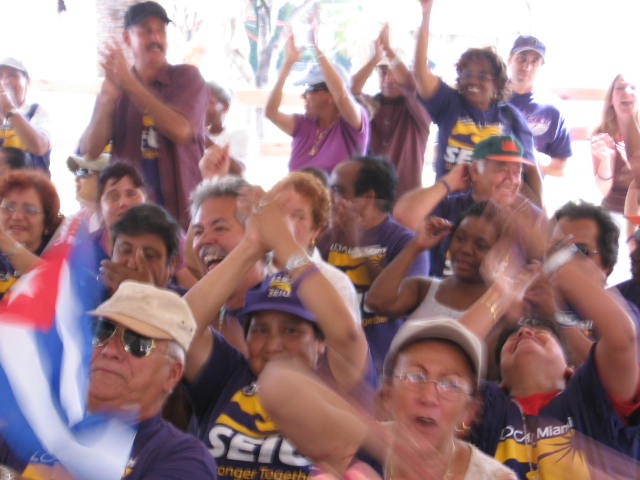
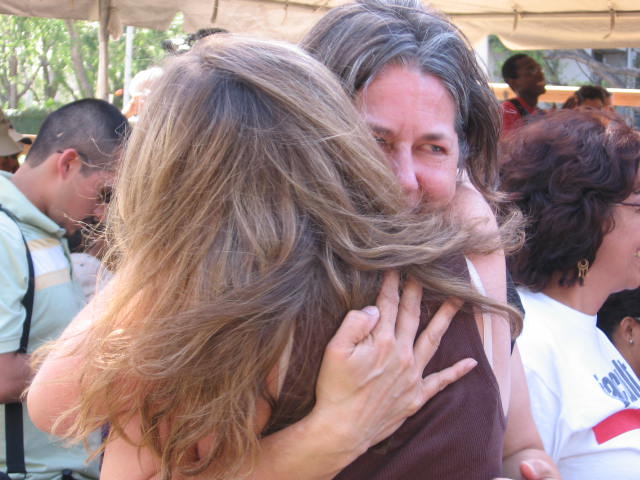
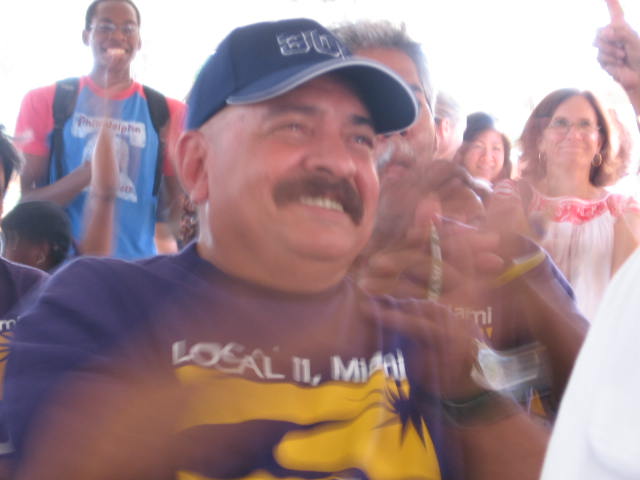
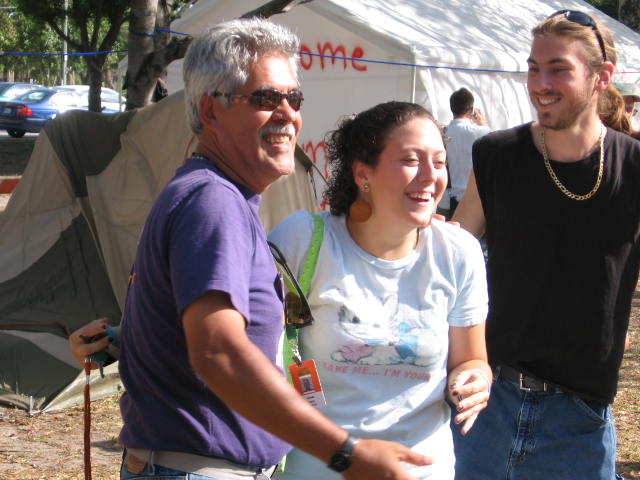
SHEER JOY

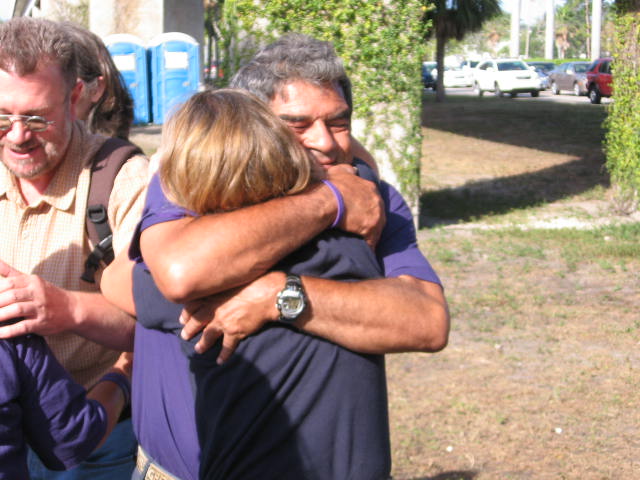
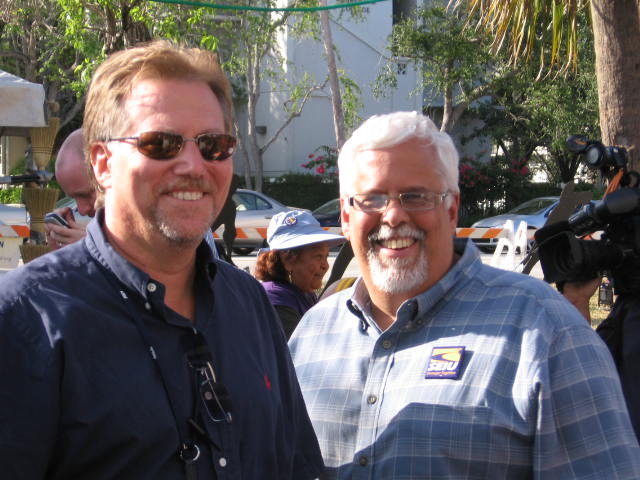
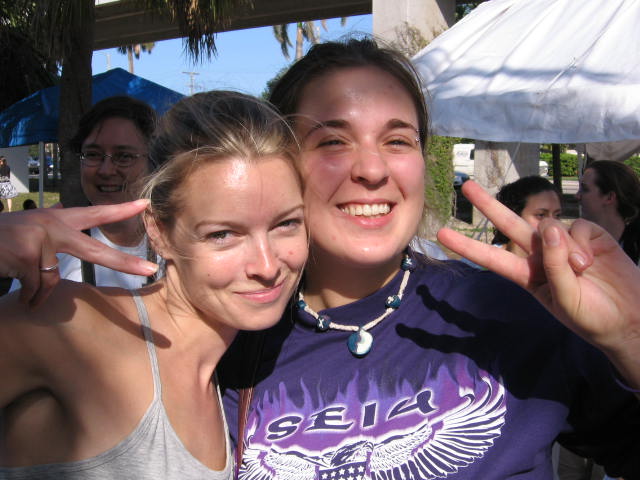
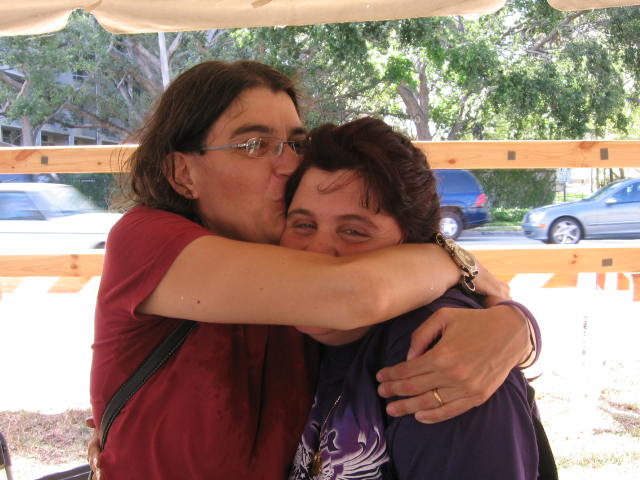
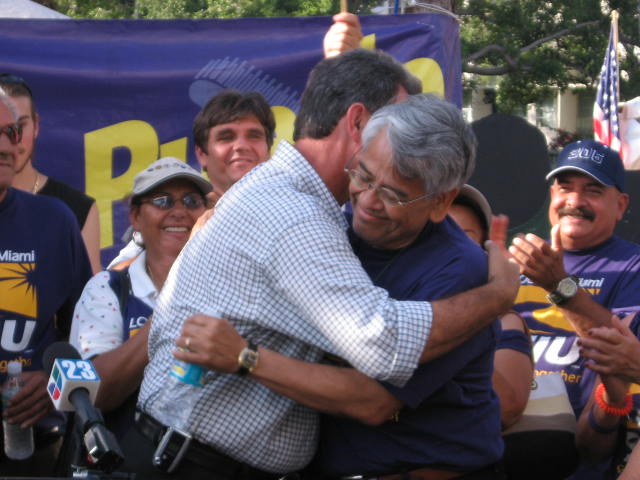
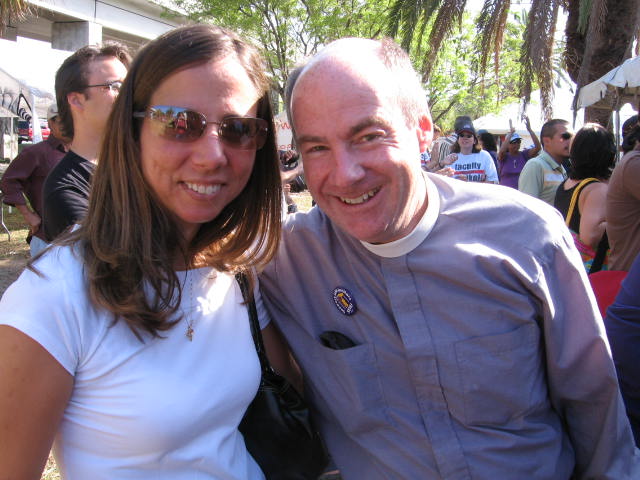
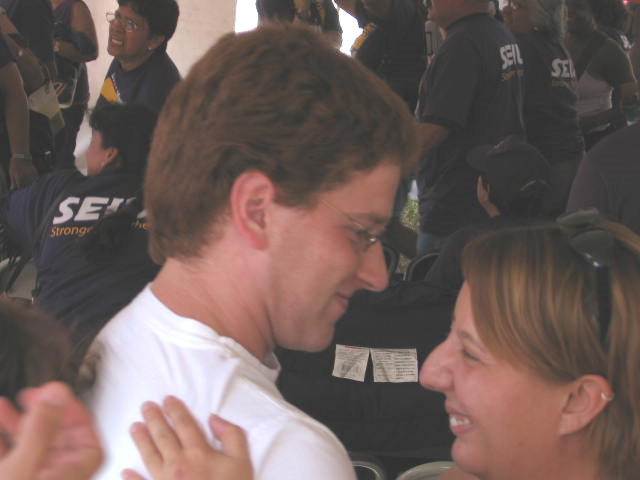
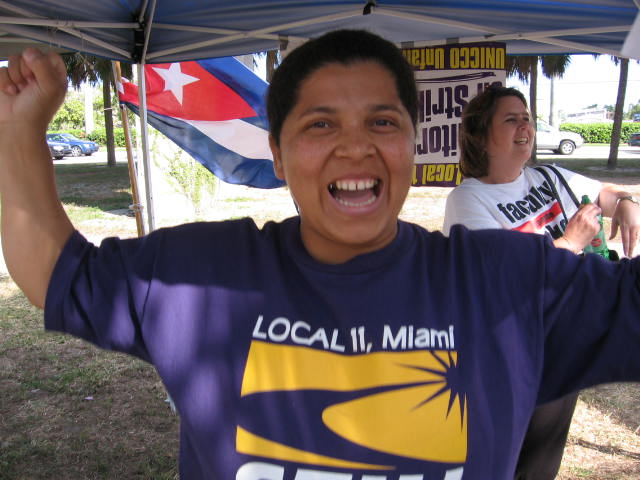
this has been long coming, considering that the events to which these pictures refer took place a whole week ago!!!! but my computer crashed, and i am the one who took the pictures, so....

... ladies and gents, enjoy these pictures and share the joy of sweet victory with the janitors, the students, the faculty, and the community who fought for justice and WON at the university of miami in the year 2006! remember you were there: you are part of history.


Thursday, May 04, 2006

Rigged Elections and True Democracy in the Workplace

The following is an op-ed written by Professor Gordon Lafer for the Miami Herald. Since the Herald has not published it, we are publishing it here. Professor Lafer is at the Labor Education and Research Center at the University of Oregon and is a national authority on card check and NLRB elections. He is the author of Free and Fair, a study commissioned by American Rights at Work about how NLRB elections fall short of the standards of democracy we hold dear.

Last Friday, the University of Miami paid to run an ad in the Herald attacking janitors’ call for their union to be recognized based on signed statements from a majority of workers. The janitors’ union criticizes the way workplace elections are run by the federal Labor Board; criticizing elections, the janitors’ bosses say, is un-American.

At first glance, it seems like the ad must be right. When most people here about “union elections,” they assume they run the same way as elections for Congress or the President. Unfortunately, nothing could be further from the truth.

The University of Miami janitors are part of a much bigger problem. Opinion surveys show that about 40 million American workers wish they had a union in their workplace. This desire is understandable ­ since workers with unions make about 30% more than their counterparts in the same type of job. But the chances of these employees realizing their desire is very small ­ because the “election” system is so highly stacked against workers.

When employees want to form a union in their workplace, they have to go through a process that none of the Founding Fathers would recognize as democratic. Instead, almost every aspect of workplace “elections” looks more like the discredited practices of rogue regimes abroad.

The starting point of any regular election is that both sides have equal access to the list of registered voters. But in a workplace election, while management can mail anti-union propaganda to workers for months, the union doesn’t even get a list of who the workers are until a few weeks before the vote. If we had elections for Congress where one candidate had access to the voter rolls for years and the other got it only in October, none of us would call that a “free and fair” contest.

But wait, it gets worse. Within the workplace, management is free to campaign against the union to every employee, every day, throughout the day; but union organizers are completely banned from the workplace. Furthermore, management can post anti-union newsletters and posters on bulletin boards and walls throughout the workplace ­ while enforcing a ban on pro-union notices.

One of the most outrageous practices is also one of the most common: forcing employees to participate in mass anti-union campaign rallies. Under federal law, employers can require workers to attend anti-union rallies. Not only are pro-union employees not given equal time, but they can be forced to attend on condition that they not say anything or ask any questions; employees who speak up despite this ban can be fired on the spot. Management can hold these forced meetings as often as it wants, up to the day before the vote.

In most union elections, supervisors are required to have repeated one-on-one confrontations with the individuals they oversee. Here, the person who has the most direct control over hiring and firing, promotion, raises, hours and duties, tells their subordinates in no uncertain terms why a union would be bad for them. The message is clear: if you ever want a raise, or a day off to take your kid to a doctor, you better not support the union.

Even “election day” itself takes place in the workplace ­ typically decked out with anti-union propaganda ­ and under the watchful eyes of managers. In 2003, former New Jersey governor Christie Todd Whitman led a Republican party delegation to observe elections in Cambodia. Whitman declared that the vote was not “free and fair,” in part because government-affiliated “village chiefs [sat] outside polling stations and check[ed] off voters as they entered and exited, providing a palpable sense they were being monitored despite casting a secret ballot.” Yet workers across the U.S. are subject to just this type of intimidation whenever they seek to establish a union.

Many of the tactics used to intimidate employees are legal. However, because federal labor law contains no possibility of punitive fines, prison, or any other type of sanction, employers break the law at will. Last year, approximately 15,000 Americans were illegally fired, suspended or otherwise financially punished for trying to form a union in their workplace. If federal elections were run with the same “Wild West” lawlessness as the workplace, the 2004 election would have seen 7.5 million voters fired, demoted or fined for backing the “wrong” candidate.

An election where one party gets preferred access to the voter list, dominates communications, forces all voters to attend its rallies, and fires voters for backing the opposition, is undemocratic and unAmerican.

Recently, labor unions have worked with employers to create alternative means for forming unions, often using local clergy or elected officials to certify that a majority of workers want the union.

University managers decry any such alternatives, seeking to condemn their employees to a rigged “election” process that none of us would accept in a campaign for county dog catcher. Shame on them.

In 2002, the State Department condemned elections in the Ukraine. Among the problems our government cited were that employees were pressured to support the ruling party; university administrators told students how to vote; and the ruling party dominated the media while restricting the opposition’s access to tv and billboards. Under the system that the University is promoting, all of these tactics are legal.

Anyone who is serious about workplace democracy has to start by insisting that we have at least as high standards for American workers as we do for voters abroad.